
| Category | Neuro Ophthalmology |
What is Optic Neuropathy?
This is the most common cause of sudden decreased vision in patients older than 40 years. We do not see with our eyes. We see with part of our brain that is capable of interpreting visual signals sent back from the eyes. This is located at the back of our head (the occipital lobes). Information is transmitted from the eyes to the brain via the optic nerves. These nerves are composed of the long tube extensions (axons) of cells (ganglion cells) located within the inner lining of the eye (the retina) that exit the back of the eye at the optic disc.
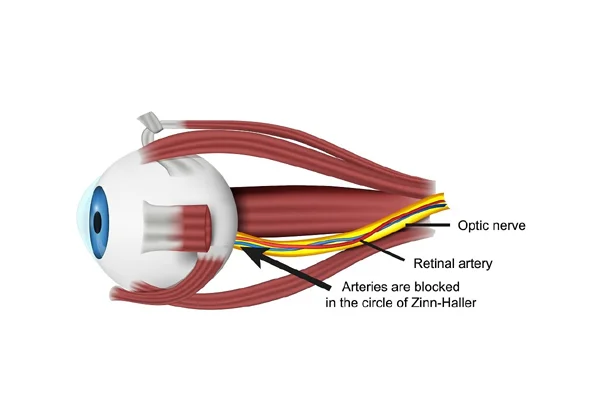
Each of the optic nerves receives blood supply from branches of the ophthalmic artery within each eye socket. The optic disc has a unique blood supply (the posterior ciliary arteries). Loss of blood supply within the posterior ciliary arteries deprives the optic nerve tissue of oxygen and results in damage to part or all of the optic nerve. This is a small "stroke" in the optic nerve.
It is painless. Patients may become aware of decreased vision or difficulty seeing above or below the center of gaze. Loss of the blood supply results in swelling of the optic disc, often associated with hemorrhages. The hemorrhages and swelling will go away leading to the development of a pale disc (optic atrophy). As the swelling resolves, some of the axons will be permanently lost.
We do know that this happens more often in patients who are born with small optic discs. These episodes may occur when there is a sudden drop in blood pressure (following an operation or associated with blood loss after an accident). Patients who smoke, or who have diabetes or high blood pressure, may be at higher risk for AION.
What are the symptoms and tests for AION?
Most patients with AION notice a sudden painless disturbance in their vision. Because of the decreased optic nerve function, however, the pupils may not react as well when light is directed into the affected eye. Swinging a flashlight between the two eyes will then show an "afferent pupillary defect." Visual field testing can identify the area of optic nerve dysfunction. Blood pressure should be checked and if there are any unusual features other blood studies may be done. In elderly patients, a blood test (sedimentation rate or c-reactive protein) can help assess the risk of giant cell arteritis.
Will I get back my vision?
Most patients with ischemic optic neuropathy will have relatively stable vision. A recent study suggests that 40% of patients may expect to have some improvement in central vision. A very small number of patients can have a worsening vision. In patients who have had AION, there is a possibility of this happening in the other eye. Fortunately, this is not common (approximately 20% chance). Probably the best news is that it is very rare for a second episode of ischemic optic neuropathy to occur in the same eye.
What is the treatment for AION?
Unfortunately, at this time there is no proven treatment for patients with AION. It has been suggested that aspirin (regular size or a baby aspirin once a day) may decrease the chance of an episode in the opposite eye. It is important that the blood pressure be followed by your doctor (elevated pressure increases risk). On the other hand, it is important that there be no sudden drop in blood pressure (overly aggressive treatment). Smoking should be stopped.


